

CASE STUDY · HISTORICAL EXPERIENCE / FOCUSED OPERATING PROJECTS
When Delivery Needs a More Dependable Operating Structure
An organization was managing ongoing projects and recurring delivery across several teams.
Work required coordination among different responsibilities, approval points, and information sources. But ownership, communication, and delivery expectations were not consistently defined.
As work continued, these gaps created repeated clarification, inconsistent handoffs, and pressure around delivery expectations.
The organization needed a more dependable way to move work from initial requests through completion.
The operating challenge
Information and decisions were spread across multiple locations. Changes in direction did not always reach everyone responsible for the work.
Project intake, approvals, and handoffs lacked consistent expectations, while competing priorities and compressed timelines increased delivery pressure.
The challenge extended beyond managing deadlines. The organization needed clearer ownership, more consistent decision boundaries, and reusable processes for recurring work.
What Malia established
Working in a historical project-management role, Malia examined the operating conditions affecting delivery.
She documented specific structural issues involving ownership, communication, decision boundaries, and information management. Leadership subsequently used her analysis to inform an immediate governance and communication response.
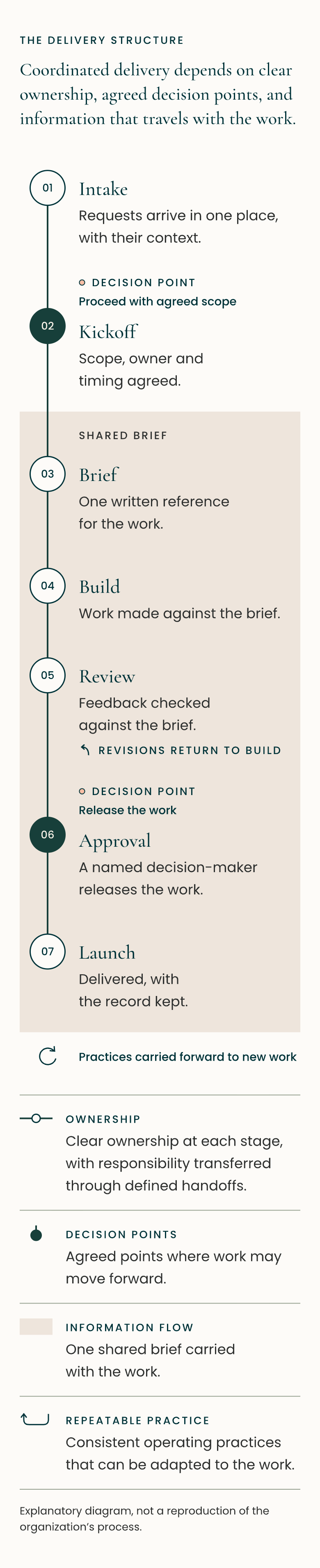
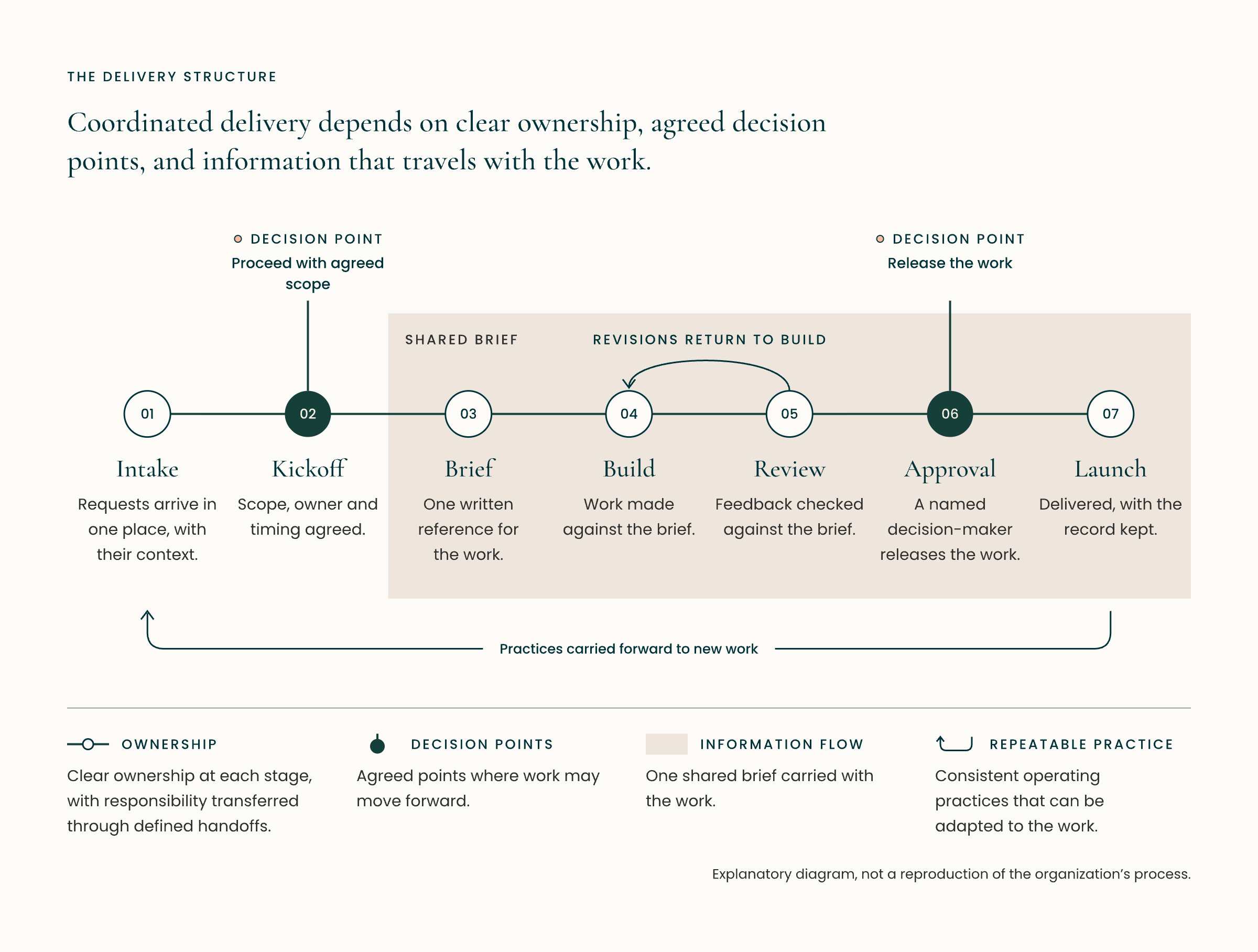
Malia also helped establish and operate more consistent delivery practices, including:
Structured intake, kickoff, and project briefs.
Clearer assignment, review, and approval expectations.
More visible ownership, dependencies, and deadlines.
Coordinated handoffs between delivery functions.
Reusable process and governance documentation.
These practices helped establish a more dependable operating structure for recurring work.
How the work progressed
Malia helped establish and operate the new delivery practices while coordinating active work across multiple functions.
Malia coordinated responsibilities across multiple functions, helping move projects through their required reviews, approvals, and delivery steps.
The work also contributed to restoring progress on an initiative whose delivery had slowed.
The recovery involved shared responsibility across the teams performing the work.
What this work demonstrates
Recurring delivery problems sometimes require more than additional project tracking.
When ownership, decisions, information, and handoffs are inconsistent, the organization needs operating practices that support how work moves between people.
This engagement demonstrates Malia's experience identifying those conditions, providing leadership with actionable analysis, establishing repeatable delivery practices, and coordinating work through changing requirements.
The verified evidence supports operational analysis, process development, leadership use of findings, and coordinated delivery. It does not establish broader financial improvements or permanent organizational change.
Historical experience and current MHC services
This work was performed in a historical Marketing and Development Project Manager role, before MHC's current service model.
The methods demonstrated are relevant to MHC's present work in operating clarity and Focused Operating Projects.