

Case Study · Fractional COO / Operating Partner Support
When a Growing Organization Needs an Operating Leadership Layer
A founder-led organization needed a more dependable way to coordinate its operations as responsibilities expanded.
Work was moving forward, but execution, financial controls, decision-making, and administrative responsibilities were not consistently connected. Much of the coordination still relied on informal communication and founder involvement.
The organization needed an operating leadership function to bring these responsibilities together.
The operating challenge
Managing individual projects was only part of the need.
Execution required clearer standards for scope, ownership, completion, and escalation. Financial and contractor administration needed more formal controls. Leadership decisions needed stronger connections to operating readiness and available evidence.
The challenge was establishing a structure through which these responsibilities could function together.
What MHC established
MHC served in a formal fractional executive operations role, with defined responsibilities for establishing and coordinating the organization's operating structure.
The work included:
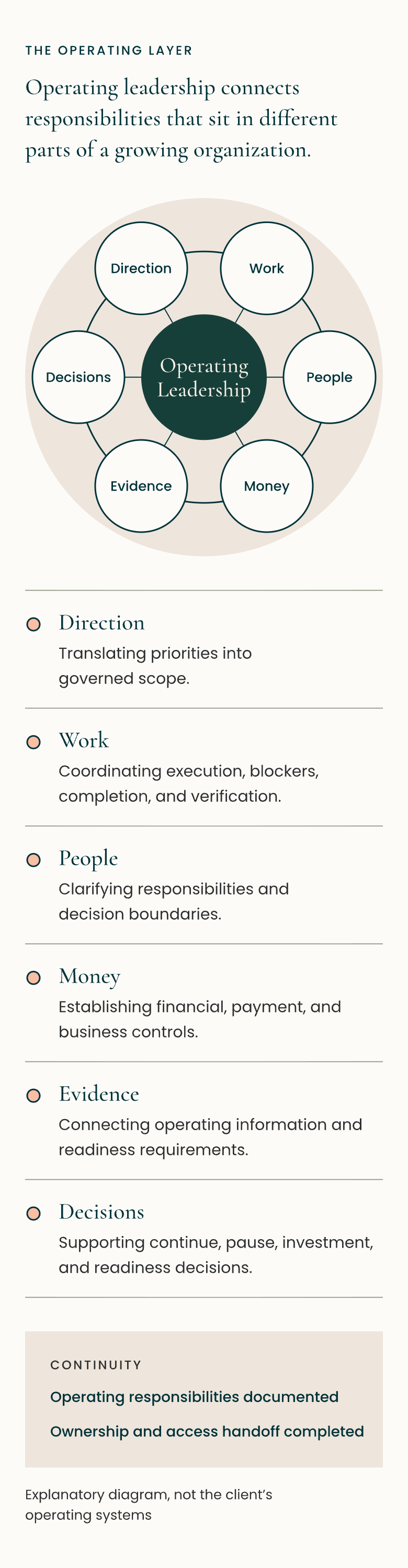
- Establishing a governed work system, recurring execution rhythm, and verification standards.
- Clarifying decision boundaries across leadership, operations, and technical execution.
- Formalizing financial, contractor, payment, accounting, and company asset controls.
- Connecting operating and financial evidence to executive decisions about readiness, priorities, and investment.
- Documenting operating processes and responsibilities to support continuity.
These changes established an operating layer connecting direction, execution, resources, and decision-making.
How the structure performed
The operating structure was implemented and used during active execution.
MHC maintained operating coordination while technical leadership and contributors carried their respective responsibilities.
The established controls supported continued execution and informed decisions about whether work was ready to proceed.
In one instance, a planned launch was held because required prerequisites were incomplete.
The engagement also included executive decision support as priorities and operating conditions changed. Final authority remained with the founder, and recommendations were not uniformly adopted.
Establishing continuity
MHC documented operating processes, administrative systems, ownership responsibilities, and work requiring continued attention.
The engagement concluded with an operating structure in use, documented responsibilities, and completed ownership and access transfers.
What this work demonstrates
Fractional operating leadership involves connecting the responsibilities through which an organization functions.
In this engagement, MHC established operating controls, coordinated execution, supported consequential decisions, and prepared the organization to carry forward documented responsibilities.
The verified results demonstrate operating infrastructure, leadership judgment, and continuity. They do not establish permanent founder independence or guaranteed business performance.
When this support is appropriate
Fractional COO and Operating Partner Support is appropriate when an organization needs ongoing operating leadership across connected responsibilities rather than a single defined project.
The work may involve execution, authority, financial coordination, accountability, and decision support as organizational conditions change.