

CASE STUDY · FOCUSED OPERATING PROJECT
When the Dashboard Exists,but the Reporting SystemDoesn't Work
The operating challenge
The organization needed a more reliable view of operating performance across several reporting areas.
The organization already had much of the information required. Data was flowing into a source spreadsheet, and the dashboard layout had been established.
But the underlying reporting system wasn't complete.
The underlying reporting problem
Without consistent identifiers and connected reporting logic, the dashboard couldn't reliably organize information across the different areas.
The visible problem was a dashboard that didn't work. The underlying problem was the structure connecting the data to the reporting interface.
How the reporting system connects
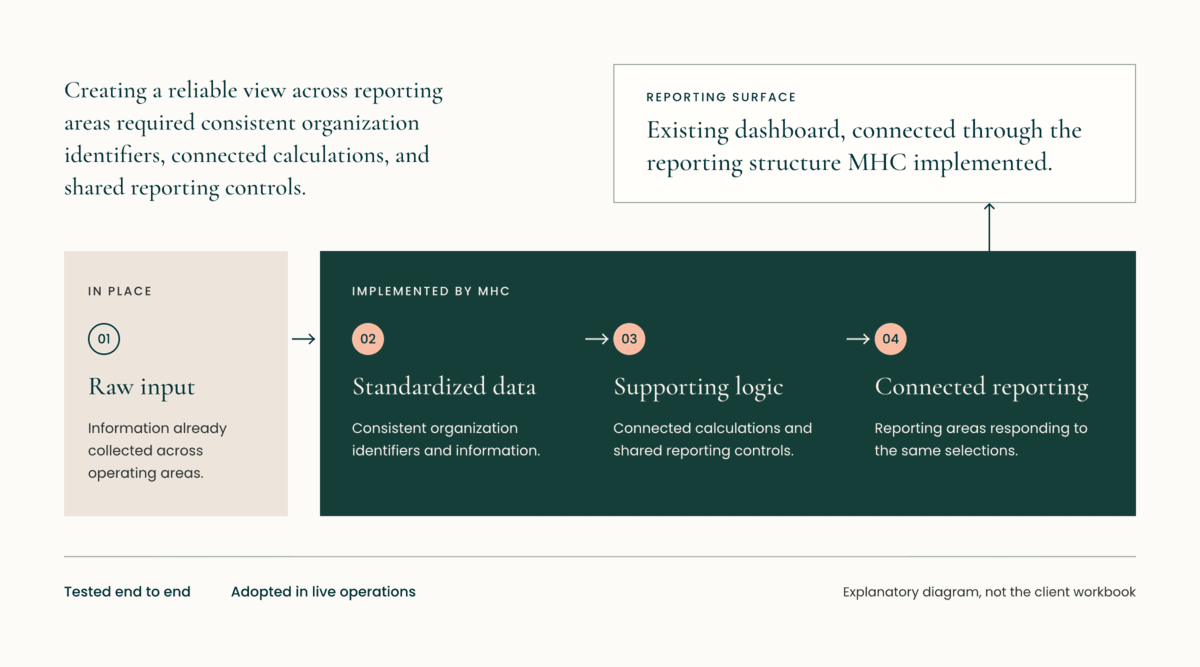
Creating a reliable view across reporting areas required consistent organization identifiers, connected calculations, and shared reporting controls.
What MHC implemented
Malia Heath Consulting focused on the data structure and reporting connections beneath the existing dashboard.
- Creating standardized data and supporting calculation layers.
- Establishing consistent organization identifiers.
- Connecting previously separate reporting areas.
- Centralizing reporting controls so different sections responded to the same selections.
- Guiding changes to future data collection to improve consistency.
- Testing the connected reporting system before handoff.
The work addressed a defined operating problem from investigation through implementation.
Verified results
The completed system connected the major reporting areas through shared controls, passed end-to-end testing, and was subsequently adopted in live operations.
What this work demonstrates
An organization might already have the information and tools needed for operational visibility but lack the structure connecting them. In this case, resolving the problem required consistent data, reliable identifiers, connected reporting logic, and shared controls. MHC addressed the underlying conditions, implemented the required changes, tested the completed system, and handed over a working solution. The engagement demonstrates how a defined operating problem becomes a Focused Operating Project.
When a Focused Operating Project is appropriate
A Focused Operating Project is appropriate when an organization has a specific operating problem requiring a defined structural change. Examples include disconnected reporting, unclear information flows, incomplete handoff structures, or operating processes that no longer support the work as intended. The objective is to understand the defined problem, build or repair the necessary structure, and leave the organization with a usable result.